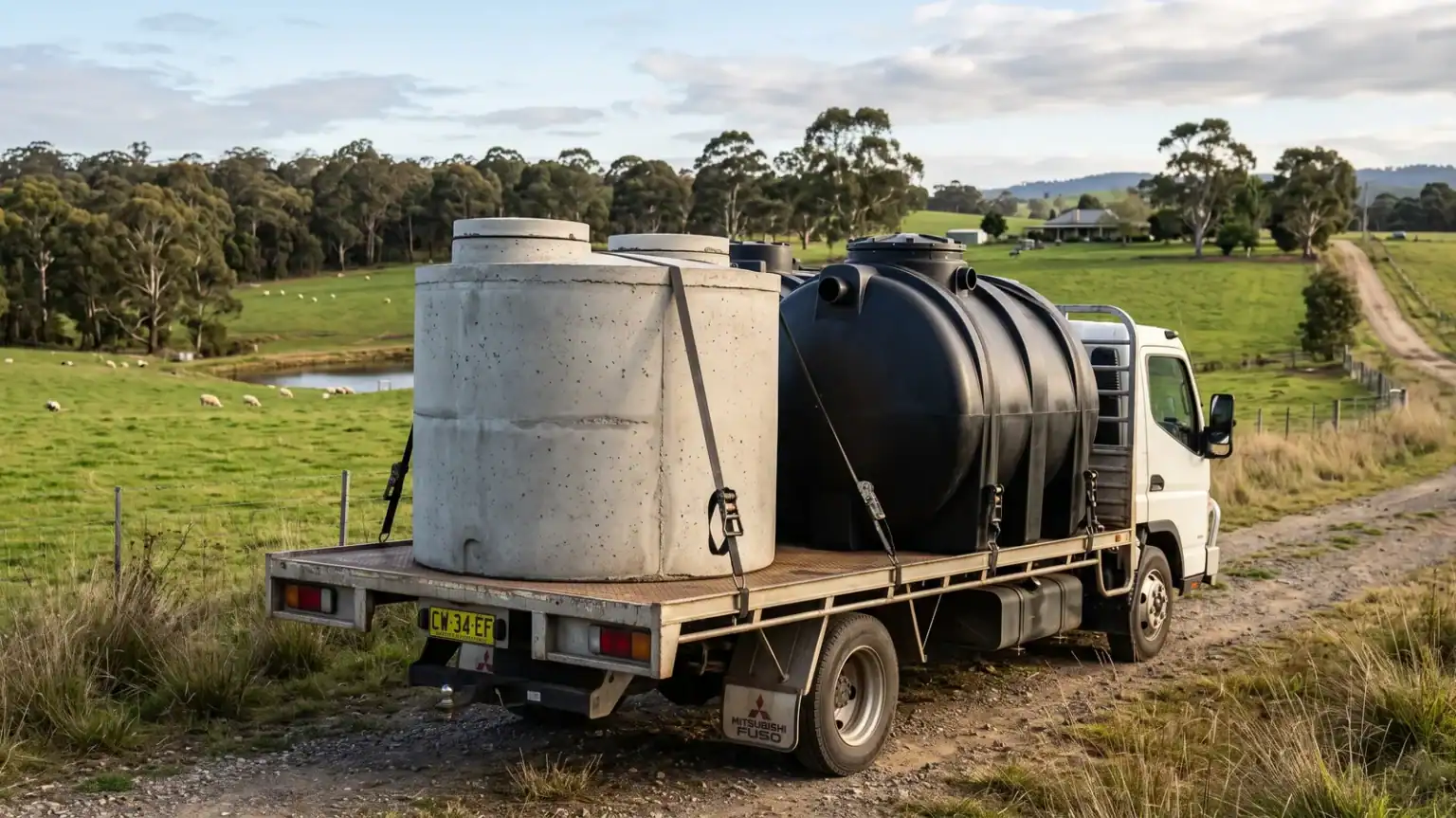
Concrete and poly septic tanks do the same job to the same standard. Concrete is heavier, stays put in wet ground and carries load. Poly is lighter, easier to get onto a difficult block and does not corrode. The block usually decides.
Most people comparing the two have been quoted one or the other and want to know if they are being steered. This guide sets out what each tank actually is, where each one wins, what can go wrong with both, and how to work out which suits your property before anything is ordered.
What both tanks have in common
A septic tank is a settling chamber. Wastewater from the house flows in, sits still long enough for solids to sink and fats to float, and the liquid in between flows out to a disposal trench where the soil finishes the treatment. Concrete and poly tanks both do exactly that, and in NSW both have to carry NSW Health accreditation before a council will approve them.
Both are sized the same way, by the number of bedrooms under the NSW Onsite Wastewater Management Guidelines, from 1,650 litres for a one bedroom home up to 4,400 litres for six. Our article on what size septic tank you need walks through that sum. The material of the tank does not change it.
Concrete septic tanks
A concrete tank is precast in a factory and delivered on a crane truck. A household size tank weighs a couple of tonnes empty, and that weight is its main advantage. It sits where it is put regardless of how wet the ground gets, it does not lift when it is pumped out, and the lid and body will carry a vehicle if the tank has to sit under a driveway or a farm track.
Concrete also lasts. A well made tank that is pumped out on schedule will commonly stay in service for forty years or more. The parts that fail first are the lid, which cracks under load, and the outlet baffle, which the gases inside the tank slowly attack. Both are repairs, not replacements.
The disadvantages are the delivery and the ground. The crane truck needs firm access close to the excavation, which rules out some steep, soft or narrow sites. And over a very long time the gases above the water line can etch the concrete, which is why an old tank should be inspected when it is opened for a pump out.
Poly septic tanks
A poly tank is moulded in one piece from polyethylene. A household size tank can be lifted by two people, so it arrives on a trailer and goes where a crane cannot. Down a narrow driveway, through a gate, across ground that would swallow a truck, or up a track a long way from a sealed road. On those sites poly is often the only practical option.
Poly does not corrode and does not react with the gases inside the tank, so the tank body is rarely the part that fails. It also tolerates ground movement better than a rigid tank. The trade is that it relies on the ground around it for strength, which puts the weight of the job on the installation. A poly tank has to be bedded on a prepared base and backfilled evenly while it is filled with water, so the walls stay supported and true.
The other limit is the water table. An empty poly tank in wet ground wants to float, so on low blocks it has to be anchored, and on the wettest sites a concrete tank is the safer call. Poly also should not have vehicles driven over it unless the tank is rated for it and installed to suit.
Concrete vs poly at a glance
| Concrete | Poly | |
|---|---|---|
| Weight | A couple of tonnes empty | Light enough for two people |
| Delivery | Crane truck, needs firm access | Trailer or ute, goes almost anywhere |
| High water table | Stays put, no anchoring needed | Needs anchoring, or choose concrete |
| Vehicle over the tank | Yes, lid and body carry load | Only if rated and installed for it |
| Corrosion | Gases can etch concrete over decades | None |
| Ground movement | Rigid, can crack if base moves | Flexes with the ground |
| Installation | Set on a level base | Bedded, filled and backfilled carefully |
| Life | Forty years plus when maintained | Decades when installed properly |
| Accreditation | NSW Health accredited | NSW Health accredited |
Where each one wins
Concrete wins on low, wet blocks. The river flats along the Manning, Macleay, Hastings and Nambucca, the estuary blocks near the coast and anywhere the water table sits close to the surface for months at a time. It also wins wherever a vehicle might cross the tank, and on properties that will stay in the family long enough for the extra life to matter.
Poly wins on access. Steep driveways up the valleys, soft paddocks after rain, tight sites behind an existing house, and remote blocks where getting a heavy vehicle in is a job in itself. On well drained, sloping ground with a low water table it is a straightforward, long lasting choice.
In practice the site and soil assessment makes the decision. It records the water table, the soil type and the slope, and once that is known the right tank is usually obvious. If both would work, the deciding factor is normally delivery access.
What goes wrong with each
- Concrete cracks when the base moves or the tank is dropped on delivery, and old lids give way under load. Both are avoided by a proper base and a sound lid.
- Poly distorts when it is backfilled empty or unevenly, and floats when it is pumped out in wet ground without anchoring. Both are installation faults, not tank faults.
- Either fails the same way in the end, through the disposal trench. The tank is rarely the part that stops working. The ground around the trench does.
The tank is not the whole job
Whichever tank you choose, it cannot be installed without council approval under Section 68 of the Local Government Act and a licensed installer to put it in. The application needs a site and soil assessment, a disposal area designed to what the ground can take and an accredited tank of the right size. Council inspects the work and issues an approval to operate once it is in. The material of the tank makes no difference to any of that.
If the assessment finds the block cannot take a trench at all, neither tank is the answer and council will ask for an aerated system such as a Biocycle instead. That is worth knowing before a tank is bought.
Frequently asked questions
Is a concrete or poly septic tank better?
Neither is better in general. Concrete is better on wet ground and under vehicle loads. Poly is better where delivery access is difficult. Both are accredited to the same standard and sized the same way.
Which septic tank lasts longer?
A maintained concrete tank commonly reaches forty years or more. A properly installed poly tank lasts decades and does not corrode. In both cases the disposal trench usually needs attention long before the tank does.
Can a poly septic tank float?
Yes, if it is emptied in wet ground and was not anchored. It is an installation issue. On low blocks the tank is anchored, and on the wettest sites a concrete tank is the safer choice.
Is a poly septic tank cheaper than concrete?
The tank itself is often cheaper, but delivery, the base and the anchoring can close the gap. The trench, the approval and the installation cost the same either way, and they are most of the job.
Do concrete and poly tanks need the same council approval?
Yes. Any new or replacement septic system in NSW needs approval under Section 68 before work starts and an approval to operate afterwards. The material of the tank does not change the process.
Choosing the right tank for your block
Get the site and soil assessment done first. It tells you the water table, the soil and the slope, and with those known the choice between concrete and poly is usually clear. If both would work, think about how the tank will get to the hole. Then make sure whichever tank you settle on is accredited and sized to the bedrooms, because that is what council will check.
We supply and install both types across the Mid North Coast, and we will tell you which one suits the block rather than which one is on the truck. If you would like a recommendation for your property, get in touch for a quote.

